American Politics as Neo-Romanticism: Is Trump a Byronic Hero?
Is there anything romantic about modern life? I think this is a really interesting question because it’s so difficult to answer in our current political climate. If we look at American culture and government, it is clear America has deeply internalized Enlightenment values like rationalism, civilization, and science. It makes sense that the ideals of the Enlightenment have endured to this day in America because the country was born from this school of thought—many Enlightenment values are baked into our Constitution. The overwhelming majority of people think civilization is superior to the natural world, viewing the latter as chaotic, unordered. The way decisions are made is largely evidence-based, rational. Even in the humanities, there is a great deal of quantitative research.
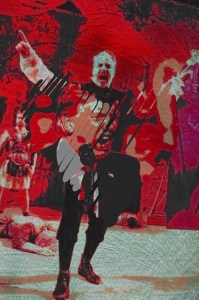
Donald Trump in the heart of Faustus as played by Chris Noth. Illustration by Cristina Henriquez
At the same time, we now have a president who was not the rational (read: Enlightenment) choice. While the majority of voters selected the most qualified and rational candidate, Secretary Clinton, the winner of the election according to our rules was more of a Romantic figure. When I think of a truly romantic (in the literary sense) way of thinking, it is Nietzsche who comes to mind. However, according to Susan Brantly (2018), “romanticism values the subjective point of view,” and who embodies this more than the perpetual espouser of “alternative facts,” President Trump?
Gabriela Poole’s explication of the “Byronic persona” notes that this figure uses his bombastic presence as an “instrument of domination” (2010, p.1). At reading this I am of course reminded of Donald Trump literally “looming” over Secretary Clinton during the presidential debate (Diaz, 2016). Those of this character type are “fundamentally rebellious and generally have a dark side” (Brantly, 2018). Furthermore, this type “avoid[s] a clear statement of the truth” (Brantly, 2018), and there is no public person who does this louder than President Trump (#taxreturns). While it seems odd to describe Trump’s way of communicating as romantic irony because of the contemporary connotations of such words, I think it is technically accurate.
I think we might have quite a bit of insight to gain by seeing Trump as a romantic figure. President Obama seems to be a true follower of Enlightenment thinking with his exceptional accomplishments as a scholar and professor of law. Secretary Clinton was cut from the same cloth as President Obama, a highly accomplished scholar herself who reached the top of a profession requiring exceptional skill in rational (logical) thinking. It makes sense that people weary of Enlightenment thinking would be moved by Trump’s romantic style of engagement: emotional, wild, irrational, unintelligible, ironic. Such was the birth of the original romantic movement in the 19th-century. Perhaps this perspective can shed some light on the current fascination with such figures the world over.
References
Brantly, S. (2018). Romanticism [lecture]. Scandinavian Studies 424: 19th-Century Scandinavian Fiction. University of Wisconsin – Madison.

 Cristina Forever