
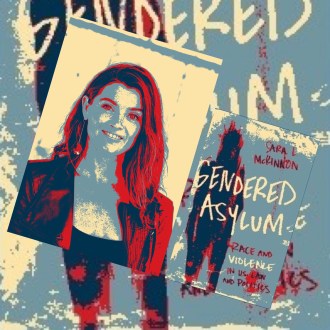
Sara L. McKinnon’s (2016) work on the deployment of female genital mutilation rhetoric to enshrine American paternalistic interventionist practices abroad by otherizing foreign governments and continents was fascinating. It was another reminder that we must look inward when attempting to redress human rights violations (McKinnon, 2016). Through the strategic employment of spatializing language, American foreign policy gains a knight in shining armor mythos (McKinnon, 2016). This halo exempts the US government from enacting any more serious legislation to address the much more rampant gender-based violence and rape culture within its own borders while still maintaining a reputation as a bastion of freedom and equality for women (McKinnon, 2016). There is no attempt made to codify into law protections against genital mutilation surgeries that regularly are imposed upon intersex people within the United States (Costello, 2016). While not surprising that a country that regularly intervenes in foreign matters would work to do so surreptitiously via rhetorical disapprobation, I was surprised by the complicity and sometime pioneering effort of the news media to perpetrate this agenda as in the articles McKinnon quotes from The New York Times (Rosenthal, 1996) and The Washington Post (Mann, 1996).
While many American representatives and agencies seemingly exist to protest gendered violence abroad, there fewer resources devoted to making it less difficult for victims of gendered violence to receive care, a means of escape, financial support, and successful prosecution of assailants by our government. Gendered abuse—like workplace discrimination, wage inequity, lack of childcare support or family leave, inadequate maternal medical care—that is unique to or originating in this country is reclassified as everyday challenges (if even that) that individuals must face by bootstrapping. Many people I’ve talked with are shocked to learn that the United States has the highest maternal mortality rate in the developed world (Frostenson, 2016). We also stand alone among peer countries by not securing paid family leave for workers (Fixmer-Oraiz & Wood, 2019).
These are problems unique to a highly neoliberal economy like ours that preferences unlimited wealth accumulation over care of its citizenry. The lack of strong social safety net ensures poverty persists for millions in the world’s wealthiest country (Bruch, Meyers, & Gornick, 2018; The World Bank, 2018). Even while we legislatively limit legal protections against forced pregnancy, our weak safety net disproportionately affects women who are forced to deal with childcare on their own as more often than not the requisite caretakers (Fixmer-Oraiz & Wood, 2019). Work requirements for the few safety net programs that exist strangle single-parent households (that are predominantly female-led) by making it nearly impossible to feed a family while also paying for childcare. Wisconsin is on track to add work requirements to BadgerCare (work requirements already exist for the state’s FoodShare program), the state’s Medicaid expansion program that offers health insurance to extremely poor residents (Kersick, 2018). So not only are we not helping lift women out of dangerous situations, we are paying our government to further entrench women into poverty…yet we ought to police the world?
References
Bruch, S. K., Meyers, M. K., & Gornick, J. C. (2018). The Consequences of Decentralization: Inequality in Safety Net Provision in the Post–Welfare Reform Era. Social Service Review,92(1), 3-35. https://doi.org/10.1086/696132
Costello, C. G. (2016). Trans and intersex children: Forced sex changes, chemical castration, and self-determination. In E. Gathman (Ed.), Women, health, and healthcare. (pp. 109-112). [Bookshelf Online version]. Retrieved from https://online.vitalsource.com. (Original work published nd.)
Frostenson, S. (2016, August 8). More and more women are now dying in childbirth, but only in America. Vox. Retrieved from https://www.vox.com/2016/8/8/12001348/more-women-dying-childbirth-america
Kersick, J. (2018, August 01). Work Requirements Are a Step in the Wrong Direction for Wisconsin. Retrieved from https://spotlightonpoverty.org/spotlight-exclusives/work-requirements-step-wrong-direction-wisconsin/
McKinnon, S.L. (2016). Gender violence as global phenomenon: Refugees, genital surgeries, and neocolonial projects of the United States. https://doi.org/10.1177/1532708616640002
The World Bank. (2018, April 4). Social Safety Net Programs Help Millions Escape Poverty, But Coverage Gaps Persist. Retrieved from http://www.worldbank.org/en/news/press-release/2018/04/04/social-safety-net-programs-help-millions-escape-poverty-but-coverage-gaps-persist
 Cristina Forever