
Fitness as a publicly discussed facet of identity is a relatively new phenomenon in pop culture. I attempt to explore the disruption of health and fitness privacy norms by the social media technology Instagram and its role in promoting negative social comparison. I will explain why we should be mindful of the impact of this technology on social comparison, define what social comparison is and the context-relative information norms for this practice, and then show how those norms are affected by Instagram use. I will conclude by exploring the normative value of those effects, and how the technology could be used to motivate better health outcomes for users.
Norms are how we differentiate between what is common and what is singular. Often what is common is conflated with what is acceptable. That is a precarious association as it can confer acceptability onto that which is harmful merely because it is widespread. Such is the case with body dissatisfaction among young women according to Fardouly, Pinkus, & Vartanian (2016). It is now normal for young ladies to have a negative view of their bodies (Fardouly, Pinkus, & Vartanian, 2016). While, it may be human nature to compare one’s self to others (Festinger, 1954), negative self-image ought not be deemed part and parcel with it. It is not acceptable for the majority of women to feel dissatisfied with their bodies as such sentiments are the primary drivers of disordered eating. The fact that this is gendered in and of itself suggests that this norm is external, caused by society’s treatment of one gender differently than another. According to Festinger (1954) via Fardouly, Pinkus, & Vartanian (2016) “people have an innate drive to evaluate their progress and standing on various aspects of their lives” (p. 31). When it comes to personal attributes, this evaluation is often done by social comparison.
Helen Nissenbaum (2010) explicates the importance of understanding context-relative information norms in order to determine a technology’s potential impact on privacy. She explains that norms “prescribe the flow of personal information in a given context […] When these norms are contravened, we experience this as a violation of privacy, here labeled as a violation of contextual integrity” (2010, p.127). In this way, in order to understand any potential impact on health and fitness privacy that Instagram may have, we must first delineate the roles, activities, norms, and values that existed prior to the technology’s advent. For this context is necessary as, “according to Raz’s adaptation of von Wright’s anatomy of norms, contexts are what he would call the condition of application, or the circumstances in which an act is prescribed for a subject” (Nissenbaum, p. 141). The transmission principles for fitness and health topics used to be between a person and their trainer, health care professional, or close friend/family member. Confidentiality and respect were inherent to most of the relationships between these actors and the subject of the fitness information. When the transmission of this information as public, it was still in a limited and confidential/respectful environment. For instance, one might share information with at a gathering with friends or in a professionally mediated environment like a Weight Watchers meeting. Similarly, while social comparison in person and through various media has been at play since the dawn of media—in Victorian times women compared themselves to the drawings of fashionable women in ladies’ magazines and on patterns—this also took place in private or with trusted associates like friends (Aspinall, 2012). Social comparison through mediated images was a one-way interaction: person to image. No one knew that you liked or didn’t like or saw or didn’t see an image unless you shared it with that person. Prior to the mass adoption of social media, it was relatively unheard outside fitness competitions for a person to make public their fitness level and progress. While some did document their progress with photography—”before and after” photos—they didn’t then go around sharing those images with strangers. Sharing of this information, if done at all, was largely in person. The sharer knew with whom they were sharing the information and the receiver had context by nature of knowing the sharer. These norms and values have been upended by social media like Instagram.
The architecture of Instagram and other social media have changed the context of fitness information transmission by encouraging mass impersonal disclosure (Fardouly, Pinkus, & Vartanian, 2016; Holland & Tigermann, 2017; Want & Saiphoo, 2017). Social media are unique information technologies because they are public and usually free to access. This access, however, isn’t truly free. The requirement for entry is information about the user, which is then exploited for marketing purposes. As a business model, this is immediately problematic from a privacy standpoint. While we may be accustomed to giving businesses our contact information, people don’t otherwise share personal information not directly relevant—i.e., the dress shop doesn’t know where you wore the dress, who saw you in it, what you liked about it (unless a review is given). Contrary to this norm, Instagram uses the content of photos and text to profile its users and sort them into markets for sale to advertisers. Furthermore, Instagram itself does not produce any content but relies entirely on unpaid user labor to populate its site. To entice disclosure, accounts are initially set to be public so the user must go to the effort of discovering how to make their account private. It also gamifies disclosure with its “likes” feature. Privacy norms are fully disrupted by the addition of a commenting feature. The once one-way street of social comparison through media is now interactive. This opens the door not only to positive encouragement but also systemic bullying.
The affordances of Instagram make it easier than ever to engage in social comparison (Fardouly, Pinkus, & Vartanian, 2016; Want & Saiphoo, 2017). Instagram only allows users to post photos with the option of including text in the post, which essentially discourages a contextual assessment of the content of the photo. Being an inherently visual medium delimits the depth to which users can express themselves, elevating the visual to the position of highest importance. Furthermore, the nature of the technology being a tool by which everyday people can post photos of themselves confers an authenticity to the subject-matter that is easily manipulated. The majority of accounts on Instagram are of an individual. Those individuals with more resources can have teams of people who create and modify their posts, but Instagram’s format neither requires nor encourages people to reveal that it is anyone but the singular person creating content. While many companies are on Instagram, most people follow people who appear to be amateurs, rather than professional companies. When we look at an advertisement in a glossy magazine, we know that a marketing department created the content. People are aware of that images can be retouched with programs like Photoshop and that the content is the work of several people whose job it is to create a specific impression with the image. While all of those things can be true of a photo on Instagram, most people aren’t thinking critically as they would content in a magazine. Programs like FaceTune facilitates retouching of photographs to remove imperfections and improve appearance. Unlike Photoshop, that kind of image manipulation is the singular aim of the FaceTune software [Figure 1]. It encourages you to remove or alter anything that could be perceived to be an imperfection. In this way, the new privacy norm Instagram has engendered is more an ability to hide what one really looks like whilst exposing oneself impersonally.
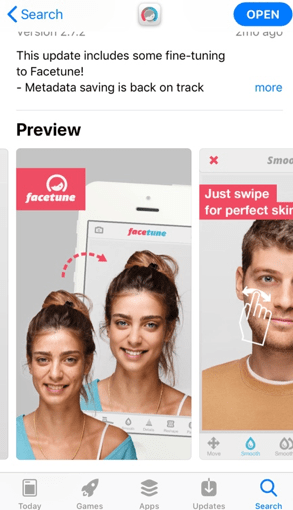
Another unique affordance of Instagram that facilitates social comparison is its ability to search similar images via hashtag as Twitter does. Hashtags can also be followed in order to see all content tagged as such. Seemingly innocuous in nature, the ability to cull thousands of photos of similar content can be problematic as in the case of #fitspiration, #thinstagram, and most disturbing #ana i.e. anorexia or #mia i.e. bulimia as Holland & Tigermann (2017) found in their experiment where women saw either fitspiration images or travel image on Instagram and then took an eating disorder risk measure. Women who saw fitspiration rather than travel images scored higher on desires for changes to their physical appearance and a fifth were deemed by the test to be at risk for a diagnosis of an eating disorder according to their answers (Holland & Tigermann, 2017). That means that merely looking at these images can trigger body dysmorphia and disordered eating. Hashtag pages for eating disorders come with a content advisory warning but don’t prevent users from seeing the images. This indicates that the warning is more to inoculate the company Instagram from liability rather than to discourage the use or viewing of the hashtag.


However, one must be careful not to come to a techno-deterministic conclusion that Instagram use is bad for one’s health. As with any technology, it is how one uses it that determines its effects. There are accounts that harness Instagram’s affordances to motivate better health outcomes and succeed in doing so. Accounts such as @alyssaschomaker (see Figure 2) reveal the wizard behind the curtain by showing how photos can be manipulated to produce impressive yet unrealistic results. Others like @iris_blasco_perez (see figure 3) could be considered positive by really underlining the connection between mental health and physical health. Eating disorders are psychological so to pretend that mental health doesn’t impact physical health ignores the central issue that must be addressed (Holland & Tigermann, 2017). Perez uses Instagram as the primary point of contact as a “Mindset, Health & Wellness Coach.” She explains, “I seriously work with my clients to try and come from a place not of dissatisfaction in their bodies, but a place of understanding the root of that emotion” (personal communication, 2018). This kind of accountability coaching recenters health and fitness disclosures in context, thus reestablishing some of the pre-Instagram information transmission norms. Such accounts share their struggles as well as their triumphs and facilitate a virtual community rather than a peanut gallery. While the privacy norms we may now have are merely superficial limits to who can see our fitness information impersonally (public vs. private profiles), we have the power to restore a healthier fitness disclosure norm and it behooves us to do so. It is clear healthy data protection makes for healthy people.
References
Aspinall, H. (12 August 2012). The fetishization and objectification of the female body in Victorian culture. Bright Online Journal (Issue 2). Retrieved from http://arts.brighton.ac.uk/re/literature/brightonline/issue-number-two/the-fetishization-and-objectification-of-the-female-body-in-victorian-culture
Fardouly, J., Pinkus, R. T., & Vartanian, L. R. (2017). The impact of appearance comparisons made through social media, traditional media, and in person in women’s everyday lives. Body Image, 20, 31-39. https://doi.org/10.1016/j.bodyim.2016.11.002
Holland, G., & Tiggemann, M. (2017). “Strong beats skinny every time”: Disordered eating and compulsive exercise in women who post fitspiration on instagram. International Journal of Eating Disorders, 50(1), 76-79. doi:http://dx.doi.org.ezproxy.library.wisc.edu/10.1002/eat.22559
Nissenbaum, H. (2010). Privacy in context: Technology, policy, and the integrity of social life, 157. 127-157.
Want, S.C., Saiphoo, A. (2017). Social comparisons with media images are cognitively inefficient even for women who say they feel pressure from the media. Body Image (volume 20, pp. 1-6). https://doi.org/10.1016/j.bodyim.2016.10.009.
 Cristina Forever