

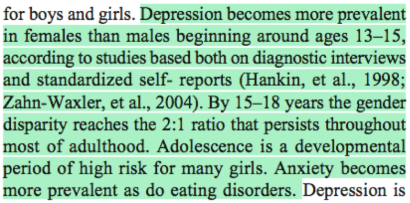
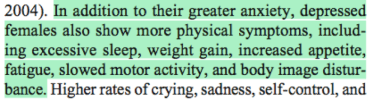
In the age of Trump, an age of unabashed sexism and robust rape culture, doesn’t it behoove us all to try to view the world through a feminist lens? I’ve found that in doing so new light is brought to the disparities in health between men and women. From a view of gender as a social construction, it became clear to me that the discussion of mental illness prevalence among women in the “Report of the Task Force on Women and Depression in Wisconsin” (RTFWDW, 2006/2016) left out an important potential cause: the burden on women of living in a patriarchal society. While I love #sadgirl culture because it’s a kind of acknowledgment and to some extent protest over the continued subjugation of women even in elite, modern American society (one of my favorites is, Melissa Broder‘s writing and tweets @sosadtoday). However, it’s not enough to admit that a lot of women are sad: we must situate it within the patriarchy to legitimize the claim that women are oppressed. It’s obnoxious because the history of women’s health islittered with doubts to the legitimacy of our claims. However, it remains true that illuminating the problem does suggest solution. The following passages from the RTFWDW seem to me to show the correlation between women’s mental health and the performance of gender society demands of them:
 (RTFWDW, 2006/2016, pp. 346)
 (RTFWDW, 2006/2016, pp. 346)
 (RTFWDW, 2006/2016, pp. 346)
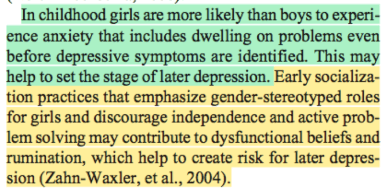
While these passages were taken from the section exploring an explanation for women’s higher rates of depression as biological, I think they show that it is not that women are intrinsically more depressive than men, but that the greatest risk factor for depression is being female-bodied in a patriarchal society. It is in adolescence that a person is expected to express their gender, it is at this time that girls are seriously differentiated from boys. This happens even in our contemporary society because while America has evolved to be less oppressive toward women, the demands on them are still extraordinary. For example, Target has just recently decided to sell a line of children’s clothes as gender neutral. That is because more and more new parents are deciding not to enforce strict gender differentiation in their children. Boys are allowed to have dolls. Girls are allowed to have trucks. However, as children become teens, gender differentiation through dress and other ways is enforced through social pressure (Rivers, 2011).
 (RTFWDW, 2006/2016, pp. 348)
 (RTFWDW, 2006/2016, pp. 348)
When women enter puberty, they lose the privilege of being seen as mostly the same as boys. As women develop physically, the way they do or do not fall within a male-gaze-dictated beauty and behavior standard becomes a daily burden. Women are societally pressured to remove the body hair that just started growing (or growing more), and rewarded for changing their natural appearance through makeup and clothing to be more sexually appealing to men. Women are expected to act in ways abnormal for a human reaction such as being kind, calm, and quiet in most situations, which puts a lot of emotional pressure on them to repress what comes naturally (Norman, 2004). A few of my friends went to all-girls high schools, and while of course there are social pressures, they say that it was such a better environment for learning because the pressure of the straight male gaze was not constantly on them. Many girls do better in single gender schools because they have more confidence in their abilities in such environments (Sullivan, 2009), which shows that “to some degree, single-sex schooling promotes a gender-atypical self-concept” (2010, pp. 51). Many women of color do better in single gender schools (Dwarte, 2014). The thing is, it isn’t that single gender schools are better—that is treating the symptom of patriarchal oppression, not the cause—it’s that they provide some relief against the societal imposition of gender. Girls’ schools enforce gender in their own ways, and that is because they still reside in our patriarchal society. It makes sense that women are more afflicted with depression as they are more oppressed in our society, and therefore under more pressure. It makes sense that women of color are more afflicted with depression because in general, they are more oppressed.
 (RTFWDW, 2006/2016, pp. 348)
 (RTFWDW, 2006/2016, pp. 349)
While this report acknowledges some of what I see as gender oppression causing depression, it still doesn’t fully draw a line between the various risk factors that are all connected to it. This is because the report doesn’t acknowledge gender as a social construction, and “normal society” as an oppressive regime in favor of men. Those who the straight white male gaze rejects are more likely to be depressed (women of color, women in poverty, immigrant women, etc.). Perhaps the biological cause may come from epigenetic effects of hundreds of years of female oppression. If women were treated equally to men, I doubt we would see this level of disparity in rates of depression. If gender was commonly accepted to be a social construction, I doubt we’d see as much gender oppression and false biological reasoning for mental illness prevalence.
References
Marquis Dwarte. (2014). The Impact of Single-Sex Education on African American Reading Achievement: An Analysis of an Urban Middle School’s Reform Effort. The Journal of Negro Education,83(2), 162-172. doi:10.7709/jnegroeducation.83.2.0162
Norman, J. (2004). Gender Bias in the Diagnosis and Treatment of Depression. International Journal of Mental Health, 33(2), 32-43. Retrieved from http://www.jstor.org.ezproxy.library.wisc.edu/stable/41345087
Report of the Task Force on Women and Depression in Wisconsin. (2016). Frequency, Causes, and Risk Factors for Depression. In E. Gathman (Ed.), Women, health, and healthcare. (pp. 141-146). Dubuque, IA: Kendall Hunt. (Original work published 2006)
RIVERS, C., & BARNETT, R. (2011). CONCLUSION. In The Truth About Girls and Boys: Challenging Toxic Stereotypes About Our Children (pp. 183-196). Columbia University Press. Retrieved from http://www.jstor.org/stable/10.7312/rive15162.13 (Links to an external site.)
Smyth, E. (2010). Single-sex Education: What Does Research Tell Us? Revue Française De Pédagogie, (171), 47-55. Retrieved from http://www.jstor.org.ezproxy.library.wisc.edu/stable/41202556
Sullivan, A. (2009). Academic Self-Concept, Gender and Single-Sex Schooling. British Educational Research Journal, 35(2), 259-288. Retrieved from http://www.jstor.org/stable/40375574
 Cristina Forever